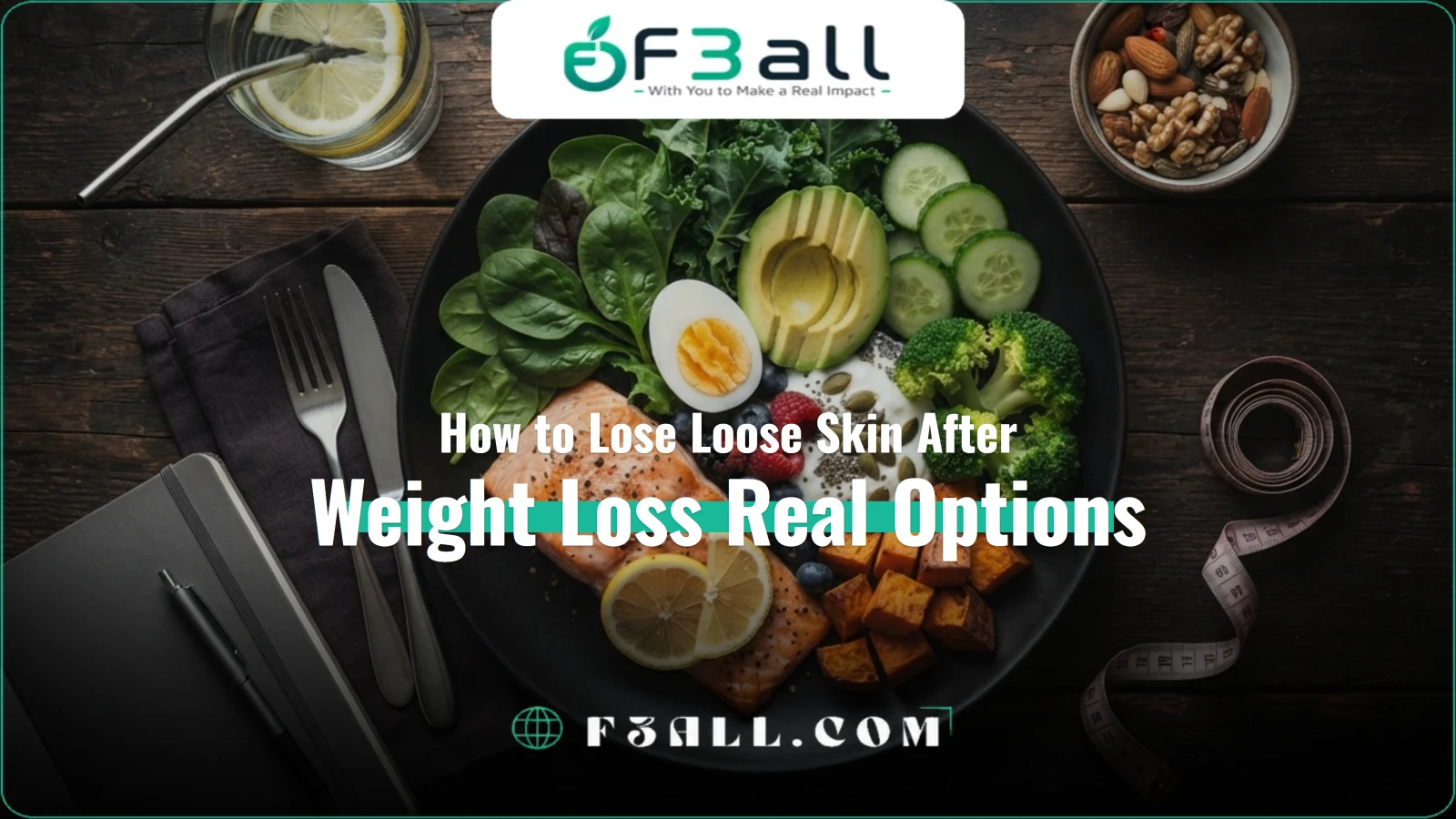
How to Lose Loose Skin After Weight Loss | Real Options
How to Lose Loose Skin After Weight Loss is a common question after a major change in body size, especially when the abdomen, upper arms, thighs, chest, or other areas still appear soft or sagging after fat loss. The important point is that loose skin is different from remaining body fat, and actual excess skin cannot always be removed through diet or exercise alone.
Some mild skin laxity may improve with time, muscle development, stable body weight, and good general skin care. Significant hanging excess skin, however, may persist after major weight loss and sometimes requires professional treatments or body-contouring surgery. Understanding How to Lose Loose Skin After Weight Loss therefore begins with realistic expectations about what natural methods can improve and what they cannot physically remove.
How to Lose Loose Skin After Weight Loss

There is no single exercise, food, cream, or supplement that reliably removes significant excess skin. The best approach depends on how much loose skin is present, whether there is still body fat underneath it, how long the skin was stretched, and your individual skin elasticity.
For mild looseness, maintaining a stable weight, resistance training, balanced nutrition, smoking avoidance, and sun protection may improve overall appearance. For substantial excess skin, medical or surgical treatments may be more appropriate.
| Option | What It May Do | Can It Remove Major Excess Skin? |
| Time at stable weight | Allow mild natural adaptation | No guarantee |
| Strength training | Improve muscle beneath skin | No |
| Balanced nutrition | Support normal tissue health | No |
| Hydration | Support normal hydration | No |
| Skin care | Improve surface appearance | No |
| Non-surgical treatments | May improve mild laxity | Usually not major folds |
| Body-contouring surgery | Physically removes excess tissue | Yes |
A Practical First Step
Before deciding How to Lose Loose Skin After Weight Loss, determine whether you are dealing with:
- Mostly loose skin.
- Mostly remaining body fat.
- A combination of both.
- Mild skin laxity.
- Significant hanging excess skin.
This distinction matters because the right strategy is very different for each situation.
Loose Skin or Remaining Body Fat?

Loose skin after losing weight can be confused with remaining subcutaneous fat. Many people actually have a combination of both.
Loose skin tends to feel thinner, fold easily, and sometimes look wrinkled. Tissue containing more body fat usually feels thicker and fuller.
| Feature | Loose Skin | Remaining Body Fat |
| Thickness | Usually thinner | Usually thicker |
| Texture | May look wrinkled or folded | Often smoother |
| Pinch | Thin fold | Thicker tissue |
| Response to more fat loss | May remain | Usually decreases |
| Response to exercise | Muscle may improve appearance | Fat can still decrease overall |
Continuing to lose weight when you are already at an appropriate body weight will not necessarily solve true excess skin.
If you are unsure, professional assessment can be helpful before making major changes to your diet in an attempt to solve How to Lose Loose Skin After Weight Loss.
Why Sagging Skin Happens After Weight Loss

Skin expands when body size increases. When a substantial amount of fat is later lost, the skin may not completely contract around the smaller body.
The final result depends on more than the number on the scale.
| Factor | Possible Effect |
| Amount of weight lost | Larger losses increase risk |
| Years at higher weight | Longer stretching may reduce retraction |
| Age | Elasticity changes over time |
| Genetics | Skin structure differs |
| Pregnancy history | Can increase abdominal stretching |
| Smoking | Can accelerate skin aging |
| UV exposure | Can damage skin structure |
| Weight cycling | Repeated stretching may affect appearance |
This explains why How to Lose Loose Skin After Weight Loss cannot be answered by copying another person’s before-and-after routine.
Give Your Skin Time at a Stable Weight
Skin appearance immediately after weight loss may not represent the final result. Mild looseness can sometimes look different after body weight has remained relatively stable for a period of time.
Weight stability is also useful before considering body-contouring procedures because surgeons generally need to understand what tissue remains after active weight loss has finished.
| Situation | Practical Approach |
| Still actively losing | Continue sustainable plan |
| Recently reached goal | Maintain and observe changes |
| Mild skin laxity | Allow time and maintain muscle |
| Major hanging folds | Professional evaluation may help |
| Weight repeatedly changing | Focus on stability first |
How much natural change occurs varies greatly between individuals.
How to Lose Loose Skin After Weight Loss is therefore sometimes partly a matter of allowing the body to reach a stable state before judging the final result.
Read more about: How to Avoid Loose Skin After Weight Loss | Key Tips
Strength Training for Loose Skin
Exercises for loose skin cannot remove excess skin, but resistance training can improve body shape by maintaining or building the muscle underneath it.
This is especially useful after substantial weight loss because preserving lean mass helps prevent a smaller body from also looking unnecessarily depleted of muscle.
| Training Area | Example Exercises |
| Chest | Presses, push-ups |
| Back | Rows, pulldowns |
| Shoulders | Shoulder presses, lateral raises |
| Arms | Curls, triceps extensions |
| Legs | Squats, lunges, leg press |
| Glutes | Hip thrusts, deadlift variations |
| Core | Controlled bracing exercises |
What Strength Training Can Do
Strength training can:
- Build muscle.
- Improve body contours.
- Support long-term weight maintenance.
- Improve strength and physical function.
- Make some loose areas appear fuller.
It cannot:
- Remove hanging abdominal skin.
- Cut away excess tissue.
- Spot-tighten skin in one body part.
- Guarantee complete tightening.
For How to Lose Loose Skin After Weight Loss, resistance training is valuable because it improves what sits underneath the skin, not because exercise physically shrinks large skin folds.
Protein After Weight Loss
Protein supports muscle maintenance and normal tissue health, making it useful after weight loss, particularly when resistance training is part of the routine.
Protein should not be marketed as a direct treatment for sagging skin.
| Protein Food | Weight | Carbs | Calories From Carbs | Protein | Total Calories |
| Chicken breast | 120 g | 0 g | 0 kcal | About 37 g | About 198 kcal |
| Tuna in water | 100 g | 0 g | 0 kcal | About 25.5 g | About 116 kcal |
| Greek yogurt | 170 g | About 6 g | 24 kcal | About 17 g | About 100 kcal |
| Eggs | 100 g | About 0.7 g | 3 kcal | About 12.6 g | About 143 kcal |
| Shrimp | 100 g | About 0.2 g | 1 kcal | About 24 g | About 99 kcal |
| Lentils, cooked | 150 g | About 30.2 g | 121 kcal | About 13.5 g | About 174 kcal |
Calories From Carbs are calculated using approximately 4 calories per gram of carbohydrate.
Adequate protein can support body composition while you work on How to Lose Loose Skin After Weight Loss, but very high protein intake will not make major excess skin disappear.
Balanced Nutrition for Skin and Body Composition
A post-weight-loss diet should continue supporting health instead of becoming increasingly restrictive because of loose skin concerns.
Meals can include lean protein, vegetables, fruit, whole grains, legumes, and measured sources of dietary fat.
| Food | Weight | Carbs | Calories From Carbs | Total Calories |
| Broccoli | 150 g | About 10.8 g | 43 kcal | About 53 kcal |
| Strawberries | 150 g | About 11.6 g | 46 kcal | About 48 kcal |
| Brown rice | 100 g | About 25.6 g | 102 kcal | About 123 kcal |
| Lentils | 150 g | About 30.2 g | 121 kcal | About 174 kcal |
| Avocado | 50 g | About 4.3 g | 17 kcal | About 80 kcal |
| Olive oil | 5 g | 0 g | 0 kcal | About 44 kcal |
A Good Meal Building Order Is
- Choose a reliable protein source.
- Add vegetables.
- Add a measured carbohydrate source if desired.
- Measure oils, nuts, seeds, and other fats.
- Include fruit or dairy according to your complete meal.
Readers can explore practical meal ideas through Delicious Diet Recipes.
How to Lose Loose Skin After Weight Loss should not involve starving the body when balanced nutrition supports muscle, health, and long-term weight stability.
Hydration and Loose Skin
Hydration and loose skin are often connected online, but drinking extra water does not physically remove excess skin.
Normal hydration can support general health and may affect how dry or hydrated the skin looks. That is very different from tightening significant sagging skin.
| Hydration Claim | Reality |
| Water supports normal hydration | Yes |
| Dehydrated skin may look drier | Yes |
| Water removes excess skin | No |
| Drinking gallons tightens skin | No |
| Water replaces treatment | No |
A sensible approach is simply to meet normal fluid needs and use water as a primary beverage.
Hydration belongs in a healthy routine for How to Lose Loose Skin After Weight Loss, but not as a miracle tightening method.
Can Collagen Tighten Skin After Weight Loss?
Collagen supplements are frequently marketed for skin elasticity after weight loss. Some research has explored collagen peptides and certain skin characteristics, but that does not establish that collagen supplements remove large folds of excess skin.
There is a major difference between improving a measure of skin hydration or elasticity and physically eliminating substantial stretched tissue.
Be Cautious With Claims Such As
- Removes loose belly skin.
- Tightens all excess skin.
- Reverses major sagging.
- Works within a few weeks.
- Replaces surgery.
- Prevents all excess skin.
Collagen may be used as an optional supplement by some people, but it should not be the main strategy for How to Lose Loose Skin After Weight Loss.
Read more about: How Much Weight Loss Causes Loose Skin | Full Guide
Skin Care and Sagging Skin
Skin-care products can improve dryness, texture, and surface appearance. Some dermatologic treatments may also improve mild skin laxity.
However, creams cannot remove large hanging folds after major weight loss.
| Option | Possible Benefit | Limitation |
| Moisturizer | Improves dryness | Does not remove skin |
| Sunscreen | Protects against UV damage | Does not tighten major folds |
| Retinoid-type treatment | May improve some skin features | Limited for major excess skin |
| Firming cream | Temporary cosmetic effect | Cannot remove tissue |
| Dermatologic treatment | May help mild laxity | Results vary |
Maintaining healthy skin is worthwhile, but How to Lose Loose Skin After Weight Loss requires separating cosmetic surface improvement from actual tissue removal.
Protect Skin From Sun Damage
Ultraviolet exposure contributes to skin aging and can damage collagen and elastin structures over time.
Sun protection will not reverse existing major loose skin, but it is a useful long-term habit when you want to preserve skin quality.
Helpful practices include:
- Avoid tanning beds.
- Use suitable broad-spectrum sunscreen.
- Use protective clothing.
- Seek shade when sun exposure is intense.
- Avoid deliberate prolonged tanning.
Protecting the skin you have is a sensible part of How to Lose Loose Skin After Weight Loss even though it cannot remove tissue that is already stretched.
Smoking and Skin Elasticity
Smoking can contribute to premature skin aging and affects much more than cosmetic appearance.
If you smoke, stopping is one of the more useful lifestyle changes for general health and skin health.
| Habit | Better Direction |
| Smoking | Work toward stopping |
| Tanning | Avoid |
| Poor nutrition | Improve food variety |
| Crash dieting | Use sustainable eating |
| Repeated regain | Focus on weight stability |
Stopping smoking is not an instant skin-tightening treatment, but it removes one avoidable factor that may negatively affect skin quality.
Loose Belly Skin After Weight Loss
Loose belly skin after weight loss is particularly common because the abdomen may undergo substantial expansion before weight loss.
Pregnancy and long-term abdominal obesity can increase the amount of stretching in this area.
Exercises such as planks or abdominal training can build core muscles, but they cannot remove hanging abdominal skin.
What Can Help the Appearance
- Maintaining a stable body weight.
- Building abdominal and total-body muscle.
- Continuing balanced nutrition.
- Allowing time after weight loss.
- Discussing professional treatments if needed.
What Cannot Spot-Remove Belly Skin
- Crunches.
- Fat-burning creams.
- Detox drinks.
- Waist trainers.
- Excessive dehydration.
- Collagen alone.
For many readers, understanding this difference is the most important part of How to Lose Loose Skin After Weight Loss.
Non-Surgical Skin Tightening After Weight Loss
Non-surgical treatments may be considered for mild or moderate skin laxity. Dermatologists and other qualified professionals may use technologies intended to stimulate tissue remodeling.
Results vary considerably, and non-surgical treatments are usually less effective for large folds of excess skin after major weight loss.
| Situation | Likely Suitability |
| Mild facial laxity | May respond to selected treatments |
| Mild body laxity | Some options may help |
| Moderate looseness | Results vary |
| Large hanging skin fold | Non-surgical treatment usually limited |
| Significant excess after major loss | Surgical consultation may be more realistic |
Avoid clinics that guarantee dramatic results before examining the skin.
When considering How to Lose Loose Skin After Weight Loss through cosmetic treatment, realistic expectations and qualified medical assessment are essential.
Body Contouring After Weight Loss
Body contouring after weight loss is the most direct option when actual excess skin is substantial. Surgery physically removes redundant tissue rather than attempting to tighten it indirectly.
Different areas may require different procedures.
| Area | Possible Body-Contouring Procedure |
| Abdomen | Abdominoplasty or related procedure |
| Upper arms | Arm lift |
| Thighs | Thigh lift |
| Chest or breasts | Individualized lift procedures |
| Lower body | Lower-body lift |
| Multiple areas | Staged procedures may be considered |
Body-contouring surgery involves scars, recovery time, risks, and cost. It is not a minor cosmetic shortcut.
When a Consultation May Make Sense
Consider professional assessment when:
- Major weight loss is complete.
- Weight is relatively stable.
- Excess skin causes physical discomfort.
- Skin folds repeatedly become irritated.
- Movement or exercise is affected.
- The appearance causes substantial concern.
- You understand that surgery leaves scars.
For significant excess tissue, this may be the most realistic answer to How to Lose Loose Skin After Weight Loss.
Read more about: Tighten Skin After Weight Loss Complete Practical Guide
When Loose Skin Becomes More Than Cosmetic
Weight loss and excess skin can sometimes create physical problems rather than simply changing appearance.
Potential issues include:
- Chafing.
- Recurrent rashes.
- Moisture inside skin folds.
- Difficulty keeping folds dry.
- Skin breakdown.
- Infection.
- Discomfort during exercise.
- Difficulty with clothing.
Persistent rashes, infection, pain, or broken skin should be evaluated medically.
How to Lose Loose Skin After Weight Loss becomes a healthcare issue when excess tissue begins affecting comfort, mobility, or skin integrity.
What Not to Do for Loose Skin
People concerned about sagging skin are often targeted by exaggerated marketing.
Common Mistakes Include
- Continuing to lose unnecessary weight hoping skin will disappear.
- Dehydrating yourself to look temporarily tighter.
- Doing hundreds of abdominal exercises for abdominal skin.
- Taking excessive protein supplements.
- Buying creams that promise permanent tissue removal.
- Assuming collagen will remove major folds.
- Using waist trainers as a skin treatment.
- Regaining weight to fill the skin.
- Ignoring persistent rashes.
- Choosing an unqualified cosmetic provider.
The safest How to Lose Loose Skin After Weight Loss strategy avoids extremes and chooses the least invasive option that can realistically address the actual problem.
A Practical Loose Skin Action Plan
Instead of trying every treatment at once, use a simple step-by-step process.
| Stage | Action |
| 1 | Confirm weight loss is complete or near complete |
| 2 | Maintain weight consistently |
| 3 | Assess whether tissue is skin, fat, or both |
| 4 | Continue adequate protein and balanced nutrition |
| 5 | Perform regular resistance training |
| 6 | Maintain basic skin care and sun protection |
| 7 | Give mild laxity time |
| 8 | Seek dermatologic advice for mild treatment options |
| 9 | Seek surgical advice for substantial excess tissue |
A Good Decision Order Is
Start with the least invasive reasonable option.
Use lifestyle habits for health and body composition, consider professional skin treatments when laxity is mild, and reserve surgical discussion for excess tissue that lifestyle measures cannot remove.
This makes How to Lose Loose Skin After Weight Loss much more practical than jumping directly from home remedies to major surgery.
Why F3all Is Your Best Choice

At F3all, How to Lose Loose Skin After Weight Loss is explained through realistic body-composition advice, balanced nutrition, resistance training, skin health, and evidence-based treatment expectations rather than miracle tightening claims.
F3all focuses on:
- Realistic skin expectations.
- Sustainable weight management.
- Protein and balanced nutrition.
- Strength training.
- Weight stability.
- Safe skin-care principles.
- Clear treatment options.
- Long-term health over quick fixes.
Readers can explore additional guidance through Weight Loss, Weight Loss Diet Plans, and Delicious Diet Recipes.
The goal is to make How to Lose Loose Skin After Weight Loss easier to understand so readers know when lifestyle changes may improve appearance and when actual excess tissue may require professional treatment.
Frequently Asked Questions
How to Lose Loose Skin After Weight Loss naturally?
Mild skin laxity may improve in appearance through stable body weight, resistance training, balanced nutrition, normal hydration, sun protection, and time.
However, natural methods cannot guarantee removal of significant excess skin after major weight loss.
Can loose skin tighten after weight loss?
Some mild looseness may improve after weight stabilizes, particularly in younger people or after smaller weight losses.
Large hanging folds after substantial weight loss are less likely to disappear completely without treatment.
How can I tighten loose belly skin after weight loss?
Core exercises can strengthen abdominal muscles but cannot remove excess abdominal skin.
Maintaining muscle, stabilizing body weight, and allowing time may improve appearance. Significant loose belly skin may require professional treatment or surgical evaluation.
What exercises are best for loose skin?
Resistance exercises that build the major muscle groups can improve body shape underneath loose skin.
Squats, presses, rows, lunges, hip thrusts, and other resistance exercises can support muscle development, but no exercise can physically remove skin.
Does protein help tighten loose skin?
Protein supports muscle and normal tissue maintenance but does not directly tighten major excess skin.
Adequate protein is still valuable because preserving muscle can improve overall body composition after weight loss.
Does drinking water tighten loose skin?
Normal hydration supports skin and overall health, but extra water does not remove or permanently tighten excess skin.
Hydration should be part of a healthy routine rather than treated as a loose-skin cure.
Does collagen remove sagging skin after weight loss?
Collagen supplements should not be expected to eliminate significant sagging skin.
Some studies have examined certain skin properties, but that is not the same as demonstrating removal of excess tissue after major weight loss.
Can creams tighten loose skin?
Creams may improve skin hydration or temporarily improve surface appearance.
They cannot physically remove large folds of excess skin, so they are not a replacement for medical procedures when significant tissue remains.
What is the best treatment for major excess skin?
When significant excess skin remains after major weight loss, body-contouring surgery is the most direct way to physically remove it.
The appropriate procedure depends on the area involved, health status, weight stability, and individual goals.
When should I see a doctor about loose skin?
Seek professional advice if skin folds cause recurrent rashes, infections, skin breakdown, pain, movement problems, or significant distress.
A qualified dermatologist or plastic surgeon can also explain whether non-surgical treatment or body contouring is appropriate.
In the End
How to Lose Loose Skin After Weight Loss depends on how severe the looseness is. Mild laxity may improve somewhat with time, weight stability, resistance training, balanced nutrition, and good skin-health habits. These strategies can improve overall appearance and body composition, but they cannot guarantee that true excess tissue will disappear.
For substantial sagging skin after weight loss, professional treatment may be necessary. Non-surgical options may help selected mild cases, while body contouring can physically remove significant excess skin. The most effective approach to How to Lose Loose Skin After Weight Loss is to identify what tissue remains, maintain a healthy stable weight, and choose treatment based on realistic expectations rather than quick-fix claims.
References